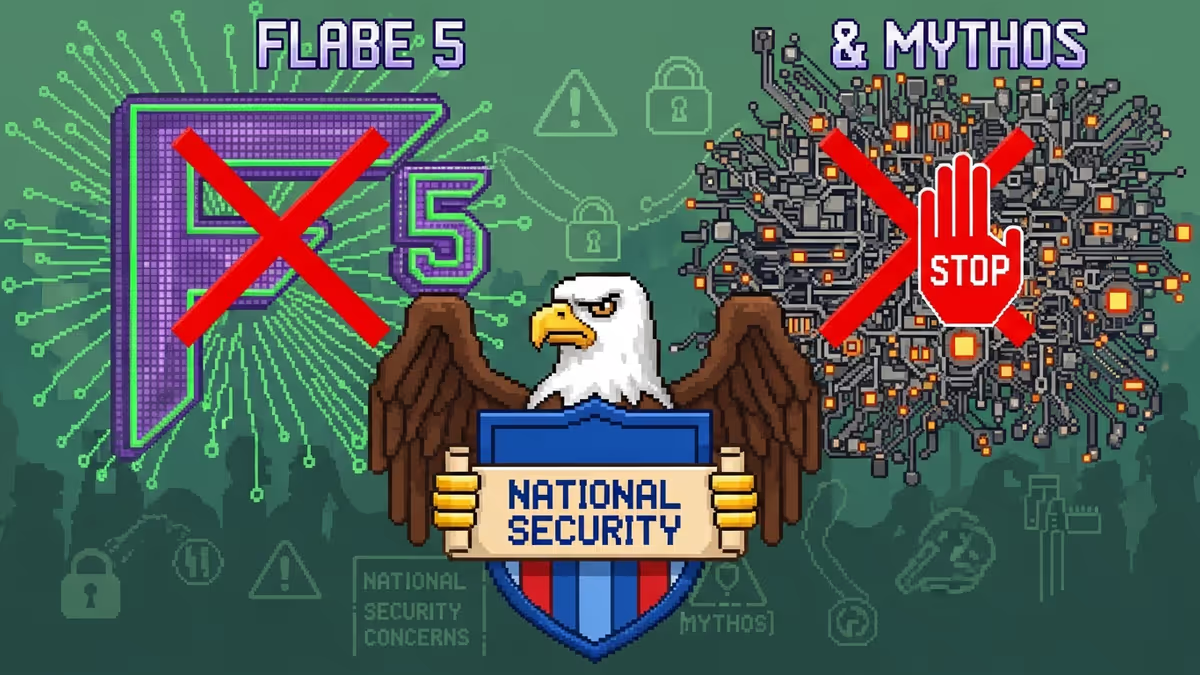
US Government Blocks Fable 5 and Mythos: National Security Concerns!
In a shocking turn of events that has shaken the artificial intelligence industry, the United States government has issued an export control directive immediately suspending access to Anthropic's Fable 5 and Mythos 5 models.
The decision, made invoking national security reasons, represents a significant precedent in the regulatory landscape of advanced AI systems. As an expert closely following the evolution of artificial intelligence technologies, I believe this episode raises crucial questions about the future development and distribution of large language models.
What Happened: Details of the Directive
The government directive, issued by competent authorities on national security matters, imposes immediate and binding restrictions. Anthropic, the company behind Claude, found itself in the position of having to abruptly disable two of its most advanced models to ensure regulatory compliance.
The Scope of Restrictions
The measures adopted are particularly stringent and present unprecedented characteristics:
- Total block for foreign nationals: any person who does not hold US citizenship can no longer access Fable 5 and Mythos 5, regardless of their geographic location
- Internal restrictions: even Anthropic employees who are foreign nationals are excluded from access to the two models
- Immediate effect: the urgent nature of the directive required an "abrupt" disabling, without significant notice to users
- Selective limitation: other models in the Claude family remain accessible without modifications
This selective approach suggests that the government's concerns regard specifically the advanced capabilities of Fable 5 and Mythos 5, rather than the entire Claude platform.
Why These Models Specifically? Possible Reasons
Although authorities have not made public the technical details underlying the decision, we can formulate some informed hypotheses based on the characteristics that distinguish high-end models.
Advanced Capabilities and Potential Risks
Models like Fable 5 and Mythos 5 likely represent the apex of Anthropic's technical capabilities. National security concerns might derive from:
Complex reasoning capabilities: particularly advanced models could be used for strategic analysis, reverse engineering of complex systems, or planning sophisticated scenarios that authorities consider sensitive.
Dual-use potential: like many advanced technologies, frontier AI models can have both civilian and military applications. The ability to generate sophisticated code, analyze vulnerabilities in computer systems, or elaborate complex strategies could constitute a risk if accessible to foreign entities.
Embedded knowledge: the most advanced models might have access to training datasets that include information considered sensitive by US authorities, even if originally public.
The Export Control Precedent
This is not the first time AI technologies have been subjected to restrictions. In 2022, the Biden administration introduced export controls on advanced chips to China, precisely to limit the development of military AI systems. The directive on Fable 5 and Mythos extends this approach directly to software models.
Technical Implications: What It Means for the Industry
This decision has repercussions that go well beyond Anthropic and its direct users.
Fragmentation of the AI Ecosystem
One of the most concerning aspects is the potential fragmentation of the global AI landscape:
# Conceptual example of geographic model segmentation
class AIModelAccess:
    def __init__(self, model_name, user_nationality):
        self.model_name = model_name
        self.user_nationality = user_nationality
        self.restricted_models = ['Fable-5', 'Mythos-5']

    def check_access(self):
        if self.model_name in self.restricted_models:
            if self.user_nationality != 'US':
                return "Access Denied: Export Control Restrictions"
        return "Access Granted"

# Scenario: A European researcher attempts to access Fable 5
researcher = AIModelAccess('Fable-5', 'EU')
print(researcher.check_access())
# Output: Access Denied: Export Control Restrictions
The creation of differentiated "access zones" by nationality risks:
- Hindering international scientific collaboration
- Creating competitive disparities between researchers and companies from different countries
- Incentivizing the development of parallel and potentially incompatible AI ecosystems
Operational Challenges for AI Companies
Companies developing advanced models now face complex operational challenges:
Geographic compliance: implementing robust systems for verifying user nationality, going beyond simple IP geolocation.
Segregated architecture: separate infrastructures might be necessary for models subject to restrictions, complicating deployment and maintenance.
Personnel due diligence: even within organizations, it will be necessary to limit access to certain models based on employee citizenship.
Anthropic's Response: "A Misunderstanding"
Anthropic has called the situation "a misunderstanding" and stated it is working to restore access. This position raises interesting questions.
Possible Scenarios
There are several possible interpretations of Anthropic's statement:
Misinterpretation of capabilities: authorities might have overestimated the capabilities or risks associated with Fable 5 and Mythos, based on incomplete information or theoretical concerns rather than demonstrated risks.
Procedural issues: the "misunderstanding" might concern procedural aspects, such as incorrect model classifications or inadequate applications of existing export control regulations.
Broken dialogue: there might have been a lack of communication between the company and regulatory authorities regarding security measures already implemented by Anthropic.
Anthropic's Safety Culture
It's worth emphasizing that Anthropic has always distinguished itself through a particularly cautious approach to AI development. The company has invested significantly in:
- Constitutional AI, a framework for aligning models with explicit ethical principles
- Research on model interpretability, to better understand their internal functioning
- Risk assessment protocols before releasing new models
This history makes it particularly surprising that its models have been targeted by a national security directive.
Geopolitical Context: The US-China AI Competition
This incident cannot be fully understood without considering the broader context of global technological competition.
The AI Race as Strategic Priority
In recent years, artificial intelligence has transitioned from being an emerging technology to a domain of strategic competition comparable to the nuclear arms race during the Cold War. Both the United States and China have identified AI supremacy as crucial for:
- National security and military capabilities
- Economic and technological leadership
- Global geopolitical influence
Export Controls as Strategic Tool
The US administration has increasingly used export controls as a tool to maintain technological advantage:
### Timeline of US Technology Restrictions (2020-2025)

- **2020**: Restrictions on Huawei and other Chinese companies
- **2022**: Controls on advanced chips (A100, H100 GPUs)
- **2023**: Limitations on semiconductor design tools
- **2024**: Extension of controls to frontier AI models
- **2025**: Directive on Fable 5 and Mythos (current case)
The directive on Fable 5 and Mythos represents a significant evolution: for the first time, restrictions directly target ready-to-use AI software models, not just the hardware or tools to create them.
Implications for Users and Companies
The immediate and long-term consequences of this decision are multiple.
For Individual Users
Non-US users of Fable 5 and Mythos find themselves suddenly deprived of access to tools on which they might have built critical workflows:
Project disruption: researchers, developers, and professionals might see ongoing projects interrupted that depended on the specific capabilities of these models.
Migration necessity: it will be necessary to identify alternatives, which might not offer the same performance or features.
Future uncertainty: even for other Claude models, uncertainty grows about their continued availability.
For Companies Integrating Claude
Organizations that have integrated Fable 5 or Mythos into their products or internal processes face particular challenges:
- Legal compliance: verifying the nationality of all users who might indirectly access the models
- System redesign: it might be necessary to reconfigure applications to use alternative models
- Customer communication: explaining sudden service interruptions can damage trust and reputation
For Anthropic's Competitors
This situation has significant competitive implications:
OpenAI, Google, and others: might see an influx of users migrating from Fable 5 and Mythos, but might also fear being the next targets of similar restrictions.
Non-US providers: European or other countries' companies might benefit indirectly, positioning themselves as alternatives not subject to US restrictions.
Ethical and Governance Issues
Beyond technical and commercial aspects, this incident raises fundamental questions about AI governance.
Transparency and Due Process
One of the most problematic aspects is the lack of transparency:
Absence of public justifications: authorities have not provided detailed explanations of the specific risks justifying the extreme measure.
Lack of notice: the "abrupt" disabling suggests there was no consultation process with the company or stakeholders.
Limited recourse: it's unclear what process Anthropic can follow to contest or clarify the decision.
This approach contrasts with principles of responsible AI governance, which emphasize transparency, accountability, and stakeholder engagement.
Balancing Security and Innovation
There exists a fundamental tension between two legitimate objectives:
National security: authorities have a duty to protect the country's strategic interests, including preventing the use of advanced technologies by adversaries.
Scientific progress and innovation: excessive restrictions can stifle research, slow innovation, and damage long-term competitiveness.
Finding the right balance is complex. Overly broad restrictions could:
- Push talent and companies to relocate to less restrictive jurisdictions
- Create a fragmented global AI ecosystem, with incompatible standards and protocols
- Damage the US technological leadership that the restrictions intend to protect
The Nationality Question
Using nationality as an access criterion raises delicate ethical questions:
Origin-based discrimination: limiting access to scientific tools based on citizenship can be perceived as a form of discrimination.
Impact on employees: the directive also affects Anthropic's foreign employees, potentially creating disparities within the organization.
Dangerous precedent: if this practice spreads, we might see a global balkanization of access to AI technologies.
Future Scenarios: What to Expect
This incident could represent a turning point. Let's examine some possible developments.
Scenario 1: Quick Resolution
If Anthropic is right in calling the situation "a misunderstanding," we might see:
- Clarifications between the company and authorities in the coming weeks
- Modifications to security measures or documentation that satisfy government concerns
- Restoration of access to Fable 5 and Mythos with possible additional compliance requirements
This optimistic scenario would depend on Anthropic's ability to demonstrate that perceived risks are manageable or nonexistent.
Scenario 2: Structured Regulation
A more likely outcome might be the emergence of a formal regulatory framework:
### Possible Framework for Advanced AI Model Controls

1. **Model classification**
   - Level 1: Base models, no restrictions
   - Level 2: Intermediate models, light monitoring
   - Level 3: Advanced models, export controls
   - Level 4: Critical models, reserved access

2. **Evaluation criteria**
   - Complex reasoning capabilities
   - Code generation abilities
   - Knowledge of sensitive domains
   - Potential for manipulation or deception

3. **Compliance requirements**
   - User identity verification
   - Logging of sensitive queries
   - Periodic reporting to authorities
   - Regular security audits

4. **Approval process**
   - Mandatory pre-release evaluation
   - Consultation with security experts
   - Controlled testing period
   - Government certification
Such a framework would provide greater predictability but might slow innovation.
Scenario 3: Global Fragmentation
The most concerning scenario involves a progressive division of the global AI ecosystem:
Western bloc: United States and allies develop advanced models with severe external access restrictions.
Eastern bloc: China and aligned countries accelerate development of autonomous alternatives, creating a parallel ecosystem.
Regional initiatives: Europe, India, and other regions invest in "AI sovereignty" to reduce dependence on both blocs.
This fragmentation could lead to:
- Inefficient duplication of research efforts
- Incompatible standards and protocols
- Difficulties in international scientific collaboration
- Increased risk of AI arms race without cooperation
Scenario 4: Escalation of Restrictions
It's possible that the directive on Fable 5 and Mythos is just the beginning:
Extension to other models: even models currently not subject to restrictions might be included as their capabilities increase.
Involvement of other companies: OpenAI, Google, Meta, and other providers of advanced models might receive similar directives.
Hardware controls: even more severe restrictions on chips necessary to train and run advanced models.
Research limitations: scientific publications on advanced AI techniques might be subject to review before dissemination.
Lessons for the AI Industry
There are important lessons the industry can draw from this episode.
The Need for Proactive Engagement
AI companies must proactively engage with regulators:
Early communication: informing authorities about new capabilities before public release, not after.
Shared security assessments: involving government experts in risk assessments during development.
Transparency on security measures: documenting and clearly communicating measures already implemented to mitigate risks.
Policymaker education: helping decision-makers understand the real capabilities and limitations of models, avoiding both hype and alarmism.
The Importance of Security Architecture
Companies should invest in architectures that facilitate compliance:
# Example of modular architecture with granular access controls
class SecureAIGateway:
    def __init__(self):
        self.access_control = AccessControlSystem()
        self.audit_log = AuditLogger()
        self.model_registry = ModelRegistry()

    async def process_request(self, user, model_id, query):
        # Verify permissions
        if not self.access_control.is_authorized(user, model_id):
            self.audit_log.log_access_denied(user, model_id)
            raise AccessDeniedException()

        # Retrieve appropriate model
        model = self.model_registry.get_model(model_id)

        # Apply safety filters
        filtered_query = self.apply_safety_filters(query)

        # Execute query
        response = await model.generate(filtered_query)

        # Log for compliance
        self.audit_log.log_usage(user, model_id, query, response)

        return response

    def apply_safety_filters(self, query):
        # Implement filters for sensitive content
        # Can be configured based on regulatory requirements
        pass
A modular architecture allows:
- Quickly enabling or disabling access to specific models
- Implementing granular controls based on nationality, role, or other criteria
- Maintaining detailed logs for audits and compliance
- Rapidly adapting to new regulatory requirements
Diversification as Mitigation Strategy
For users and companies integrating AI models:
Multi-vendor approach: avoiding critical dependencies on a single model provider.
Interface abstraction: developing wrappers that allow easy substitution of one model with another.
Continuous evaluation of alternatives: maintaining familiarity with alternative models that could replace those currently in use.
Geographic considerations: for critical applications, evaluating providers in different jurisdictions to mitigate regulatory risks.
The Role of Europe and Other Regions
This incident has important implications for non-US actors.
The European Opportunity
The European Union finds itself in an interesting position:
Regulatory alternatives: the European AI Act represents a different approach, based on risk classification rather than nationalistic export controls.
Strategic autonomy: episodes like this strengthen arguments in favor of European investments in autonomous AI capabilities.
Startup opportunities: European companies like Mistral AI could benefit as providers not subject to US restrictions.
Open Source Models as Alternative
The open source community could play a crucial role:
Universal accessibility: models like Llama, Falcon, or Mistral's open models are not subject to the same centralized controls.
Transparency: open source allows complete inspection, addressing some security concerns.
Distributed innovation: decentralized development can be more resilient to regulatory interventions by individual governments.
However, even open source models face challenges:
- Truly advanced models require enormous computational resources, still concentrating them in few hands
- Hardware export controls (GPUs) also affect open source development
- Lack of commercial support can limit enterprise adoption
Final Reflections: Toward Global AI Governance?
As I observe the evolution of this situation, I find myself reflecting on fundamental questions regarding the future of artificial intelligence as a global technology.
Technology Knows No Borders, But Regulators Do
There is an intrinsic tension between the global nature of AI research and national security prerogatives. Artificial intelligence, like the Internet before it, is fundamentally a transnational technology. The scientific knowledge that makes it possible has been developed through international collaborations. Many of the brightest researchers in the field are immigrants or work in multinational teams.
Yet, as this incident demonstrates, when technologies become strategically significant, national governments claim the right to control their development and dissemination. This is understandable from a national security perspective, but creates enormous challenges for a field that has prospered through open collaboration.
Is a New International Framework Needed?
Some historical parallels are instructive:
Nuclear weapons: after decades of uncontrolled proliferation, the international community created non-proliferation treaties, verification agencies like the IAEA, and norms against the use of nuclear weapons.
Climate change: although imperfectly, agreements like the Kyoto Protocol and Paris Agreement have created frameworks for coordinated action on a global challenge.
Cybersecurity: despite tensions, some multilateral forums exist where nations discuss norms for behavior in cyberspace.
Could AI benefit from a similar framework? An "International Agency for Artificial Intelligence" could:
- Establish common standards for risk assessment of advanced models
- Facilitate sharing of security best practices without revealing proprietary details
- Create mechanisms for verifying security measures without blocking innovation
- Provide a neutral forum to resolve disputes like the current one between Anthropic and the US government
Of course, creating such an agency would face enormous obstacles, not least the fact that major AI powers might not want to submit their capabilities to international scrutiny.
The Urgency to Act
What makes this situation particularly urgent is the accelerated pace of AI development. Unlike nuclear weapons, which required enormous and easily monitorable physical infrastructures, advanced AI models might soon be trainable with relatively accessible resources.
If we don't develop adequate norms and institutions now, while AI is still concentrated in a few organizations, we might find ourselves in a future where hundreds of actors possess advanced AI capabilities without any international coordination on risks.
My Hope for the Future
As an expert who has dedicated years to studying and promoting artificial intelligence, I remain fundamentally optimistic about its potential to benefit humanity. But episodes like the blocking of Fable 5 and Mythos remind me that technology alone is not enough.
We need:
- Continuous dialogue among developers, regulators, security researchers, and civil society
- Transparency about the real capabilities of AI systems, avoiding both hype and alarmism
- Governance mechanisms that balance security and innovation, national protection and global cooperation
- Investments in AI safety research, interpretability, and alignment
- Education of policymakers and the public about the real opportunities and risks of AI
The Fable 5 and Mythos incident, whatever its final outcome, offers us a valuable opportunity. It's a wake-up call reminding us that we must address AI governance issues proactively, not reactively. We must create structures that allow us to reap the benefits of AI while protecting against risks, that facilitate innovation without compromising security.
It won't be easy. It will require difficult compromises and navigating divergent national interests. But the alternative—a world where AI development proceeds in closed national silos, with incompatible standards and without cooperation on shared risks—would be much worse.
While Anthropic works to "restore access as soon as possible," all of us in the AI ecosystem should work to build a future where sudden disruptions like this become increasingly rare, replaced by transparent, predictable, and fair processes for governing the most powerful technologies ever created by humanity.
The stakes couldn't be higher. Let's make sure we rise to the challenge.