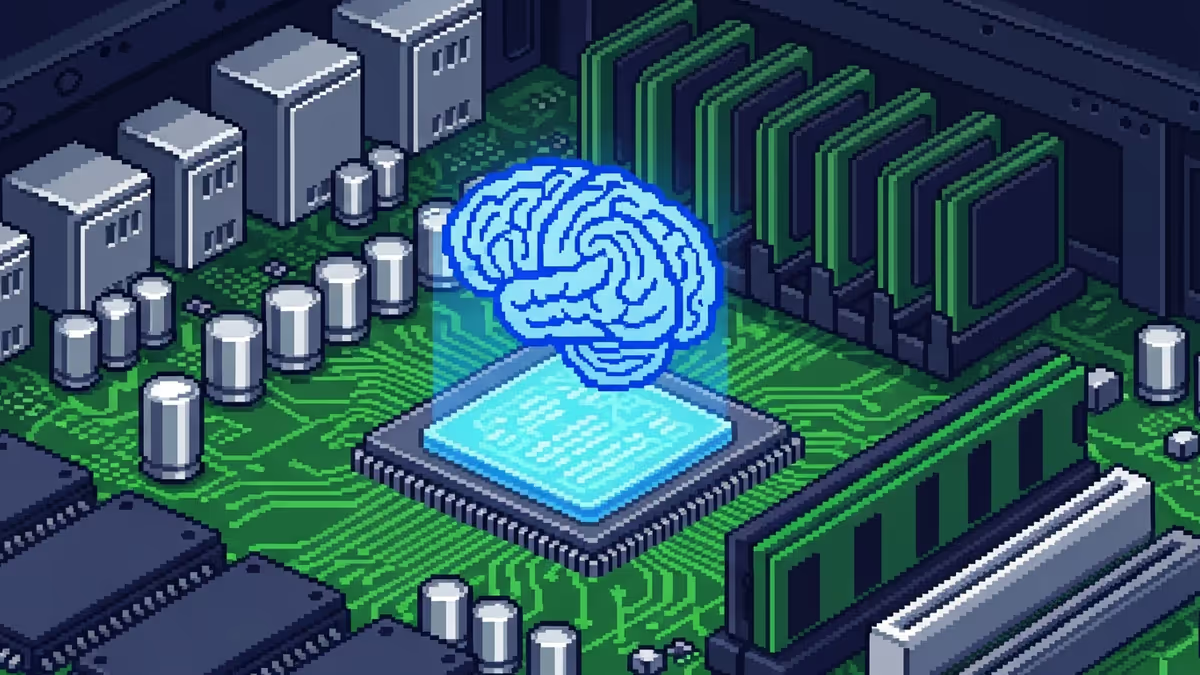
The growth of AI is no longer just a matter of algorithms but primarily of hardware
We're experiencing a silent yet profound transition. While until yesterday we talked about LLMs, parameters, and datasets, today the real bottleneck of artificial intelligence has shifted to a level that many—perhaps too many—had underestimated: hardware. It's no longer the code that's the limit, but the silicon. And this revelation is redesigning the priorities of the entire tech industry.
When I started working with AI, the debate revolved around algorithm optimization, data quality, and neural architecture. Today, if we're honest with ourselves, we must admit that the game has moved elsewhere. Innovation no longer comes only from research labs perfecting models, but from clean rooms where neuromorphic chips are designed and from factories assembling liquid cooling systems.
2026: The Year of AI Hardware Consumerization
According to an analysis by the Tech Industry Forum, 2026 will mark a turning point. It won't be remembered as the year of model X or algorithm Y, but as the year when hardware and devices stole the show. The reason is simple, almost obvious: to reduce latency and bandwidth costs, AI is moving from cloud processing to edge computing.
This migration isn't a stylistic choice, but a technical and economic necessity. Think about how many times an AI application on a smartphone must query remote servers to process a response. Every millisecond of latency, every megabyte transferred, represents a cost. Multiplied by billions of daily transactions, it becomes unsustainable.
The paradox is that we have increasingly sophisticated models, but their practical utility is limited by the infrastructure supporting them. It's like having a Ferrari engine mounted on a Panda: the theoretical performance is there, but the chassis can't express it.
Beyond Silicon: Photonics as a Necessity
In February 2026, Elettronica News published a technical analysis that many in the sector defined as "illuminating," and it's no coincidence they used precisely that adjective. The article explores the transition from electrical to optical transmission in AI data centers.
Copper, the material that for decades served as the backbone of our computing infrastructure, has reached an insurmountable physical limit. It's not a matter of material quality or cable engineering—it's physics itself that imposes a constraint: beyond a certain frequency and data density, the electron just can't keep up.
Silicon photonics, meaning the integration of optical interconnections directly on chips, is therefore not a technological upgrade but a necessary condition to avoid stagnation. Without this paradigm shift, the training speed of AI models risks flattening out, regardless of how brilliant the algorithms we develop are.
I'm struck by how this transition represents a return to the basics of physics. After years spent optimizing software layers, we find ourselves having to solve problems of light propagation and thermal dissipation. It's a humble reminder: digital innovation cannot disregard the laws of nature.
The Numbers Redefining Priorities
Deloitte's 2026 Global Hardware and Consumer Tech Industry Outlook report puts in black and white what many industry operators already sensed: the AI chip market will reach $500 billion in 2026. Half a trillion dollars. This isn't a niche market—it's an industry comparable to automotive.
But the data that made me reflect most concerns data centers. Deloitte highlights that enterprise AI growth today depends on the ability to build facilities "on a gigawatt scale." Gigawatt. We're talking about the energy consumption of a medium-sized city. And without liquid cooling systems, this new generation of hardware simply couldn't function.
It's a radical change in perspective. AI is no longer a matter of software houses and startups working on laptops in coworking spaces. It's heavy engineering, energy infrastructure, applied thermodynamics. It requires investments that only a few global players can afford, and this is inevitably concentrating power.
Strategic Implications for Those Working in AI
As a professional in the field, this transformation poses uncomfortable questions. If the real competitive advantage has shifted to hardware, what does this mean for those working on software? The answer isn't simple, but I believe it involves greater awareness of physical constraints.
We can no longer design models assuming infinite and free computing resources. We must return to thinking like engineers, not just as data scientists. Energy efficiency, latency, computation localization aren't implementation details—they're primary design constraints.
Three Concrete Directions
I see three directions along which we must move:
-
Hardware-aware design: models must be conceived with the specific characteristics of the chips they'll run on in mind, leveraging their architectural peculiarities.
-
Cloud-edge hybridization: not everything must run locally, not everything can stay in the cloud. We need an intelligent distributed architecture that optimizes latency, bandwidth, and consumption.
-
Sustainability as a constraint: a model that requires the energy equivalent of a small city to train isn't just expensive—it's ethically problematic. Sustainability must enter evaluation metrics.
The Risk of Concentration
There's an elephant in the room we need to talk about: this critical dependence on hardware is creating very high barriers to entry. If being competitive in 2026 AI requires gigawatt data centers with integrated photonics and liquid cooling, how many players can actually play this game?
The risk is an oligopolistic concentration of computational power in the hands of a few global players. And when computational power becomes synonymous with the ability to develop and distribute AI, we're talking about a concentration of power tout court.
I don't have easy solutions to propose, but I believe it's essential to maintain high attention on this issue. The democratization of AI, which was talked about so much in the early years of deep learning, risks being a utopia if access to hardware becomes the real selective filter.
Rethinking the Role of Innovation
This historical phase forces us to redefine what we mean by "innovation in AI." For years, innovating meant finding new neural architectures, inventing more sophisticated attention mechanisms, expanding datasets. All of this remains important, but it's no longer sufficient.
Innovation today also means, perhaps above all, finding ways to do more with less. Compressing models while maintaining their capabilities. Designing specialized chips for specific tasks. Optimizing photon paths inside a silicon wafer.
It's a less glamorous type of innovation, closer to classical engineering than computer science. But it's the innovation that will determine who will succeed in scaling AI in the coming years and who will fall behind.
Conclusion: Looking Beyond Algorithms
If there's one lesson these developments teach us, it's that artificial intelligence is not a standalone discipline. It's deeply interconnected with materials physics, energy engineering, thermal design. Ignoring these aspects means building houses of cards, however algorithmically sophisticated.
As AI professionals, we must broaden our horizon. We can no longer afford to think only in terms of parameters and layers. We must understand watts, nanometers, latency in communication buses. We must dialogue with those who design chips, with those who build data centers, with those who study advanced materials.
2026 is not the year when hardware stole the show from AI. It's the year when we finally understood that hardware and algorithms are two sides of the same coin. And that to truly progress, we must think about them together, from the beginning.
The next artificial intelligence revolution won't be written in Python. It will be manufactured in a clean room, one photon at a time.