Introducing full-stack vibe coding in Google AI Studio
Google has just raised the bar in AI-assisted software development. With the introduction of the new full-stack vibe coding system in Google AI Studio, we're witnessing a paradigm shift that completely redefines the relationship between developers and AI-powered development tools. As an AI expert closely following these technological evolutions, I'll guide you through an in-depth analysis of this innovation.
What "full-stack vibe coding" really means
The term "vibe coding" might sound like marketing buzzword, but it conceals a sophisticated generative AI architecture. This is an approach that goes beyond simple code completion: we're talking about a system capable of interpreting the developer's high-level intent and translating it into a complete application, structured across multiple technological layers.
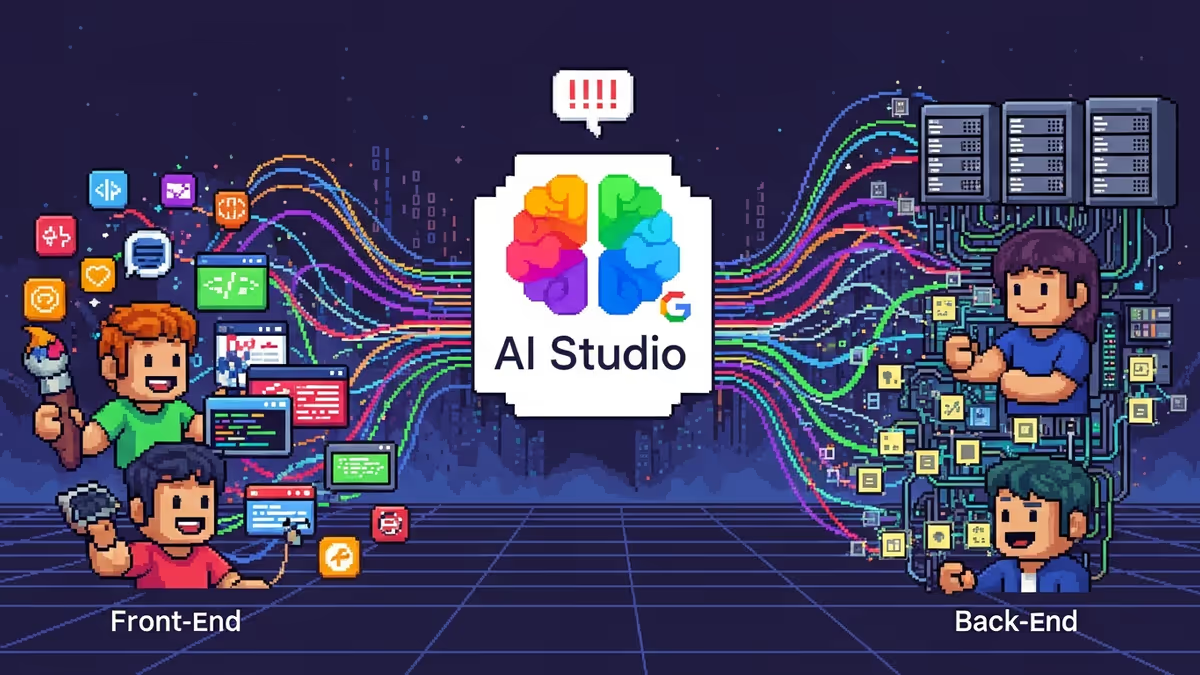
The substantial difference compared to previous AI coding assistance tools lies in the ability to simultaneously orchestrate:
- Frontend with complex UI elements
- Backend with application logic
- Cloud infrastructure
- Authentication systems
- Database management
All of this starting from natural language prompts, without requiring preliminary manual configurations.
The architecture behind Antigravity: the new AI agent
At the heart of this experience we find Antigravity, the AI agent that Google developed specifically for this purpose. Technically, Antigravity represents a significant evolution compared to traditional code generation models.
Technical capabilities analysis
Antigravity operates on three levels of abstraction:
- Contextual understanding: interprets the user's prompt not only from a syntactic perspective, but by analyzing the overall application intent
- Architectural planning: generates a coherent application structure, autonomously deciding which technological components to integrate
- Orchestrated implementation: writes code across multiple files, manages dependencies, configures cloud services
The real innovation lies in the fact that Antigravity doesn't simply generate code: it builds an architecture. This means the model has learned established architectural patterns and knows when to apply them.
// Example of output generated by Antigravity
// Automatically generated file structure for a collaborative app

// client/src/App.jsx
import { initializeApp } from 'firebase/app';
import { getFirestore, collection, onSnapshot } from 'firebase/firestore';
import { getAuth, signInWithPopup, GoogleAuthProvider } from 'firebase/auth';

const firebaseConfig = {
  // Auto-generated configuration linked to the project
};

const app = initializeApp(firebaseConfig);
const db = getFirestore(app);
const auth = getAuth(app);

// The rest of the app is generated with complete logic
Intelligent cloud resource provisioning
One of the most interesting aspects from a technical standpoint is the proactive provisioning system. Antigravity doesn't wait for the developer to explicitly request a database or authentication system: it detects them as architectural necessities.
The detection mechanism
When analyzing the prompt and generated code, the agent uses an inference system that:
- Identifies patterns requiring data persistence (keywords like "save", "store", "share between users")
- Detects identity management needs (references to "users", "profiles", "permissions")
- Automatically activates provisioning of corresponding resources
This happens through integration with:
- Cloud Firestore: for NoSQL database
- Firebase Authentication: for identity management
- Cloud Run: for containerized deployment
# Auto-generated Cloud Run configuration
apiVersion: serving.knative.dev/v1
kind: Service
metadata:
  name: my-generated-app
spec:
  template:
    spec:
      containers:
      - image: gcr.io/project-id/app-image
        env:
        - name: FIRESTORE_PROJECT_ID
          value: auto-configured-project
        resources:
          limits:
            memory: 512Mi
            cpu: 1000m
Multiplayer applications: real-time architecture
The ability to generate multiplayer experiences is particularly significant. Traditionally, implementing real-time synchronization between clients requires specific expertise in:
- WebSocket or similar technologies
- Distributed state management
- Conflict resolution
- Latency compensation
Antigravity abstracts this complexity using Firestore's real-time listeners, but does so in an architecturally correct way.
Implemented synchronization patterns
// Example of generated code for multiplayer synchronization
const gameStateRef = collection(db, 'gameStates');
const roomId = 'generated-room-id';

// Auto-configured real-time listener
const unsubscribe = onSnapshot(
  doc(gameStateRef, roomId),
  (snapshot) => {
    const gameState = snapshot.data();
    // Contextually generated UI update logic
    updateGameBoard(gameState.board);
    updatePlayerPositions(gameState.players);
  },
  (error) => {
    // Complete error handling
    console.error('Sync error:', error);
    handleDisconnection();
  }
);
The agent also generates race condition handling logic, implementing patterns like operational transformation or CRDT (Conflict-free Replicated Data Types) when necessary.
Secure third-party service integration
Another relevant architectural element is API credentials management. Antigravity implements a system that:
- Recognizes when external service integration is needed
- Generates boilerplate for integration
- Manages credentials securely using Secret Manager
This is fundamental because one of the historical problems of AI code generators has been the tendency to hardcode API keys or mishandle secrets.
// Secure integration pattern generated by Antigravity
import { SecretManagerServiceClient } from '@google-cloud/secret-manager';

const client = new SecretManagerServiceClient();

async function getApiKey(secretName) {
  const [version] = await client.accessSecretVersion({
    name: `projects/${projectId}/secrets/${secretName}/versions/latest`,
  });
  return version.payload.data.toString();
}

// Secure usage in API calls
const stripeKey = await getApiKey('stripe-api-key');
const stripe = require('stripe')(stripeKey);
Cloud Run deployment: from idea to production
The pipeline from prompt to deployment is fully automated. Technically, this involves:
- Containerization: automatic generation of optimized Dockerfiles
- Build: compilation via Cloud Build
- Deploy: provisioning on Cloud Run with appropriate configuration
- Networking: automatic DNS and HTTPS setup
Automatically generated Dockerfile
# Optimized multi-stage build generated by Antigravity
FROM node:18-alpine AS builder
WORKDIR /app
COPY package*.json ./
RUN npm ci --only=production
COPY . .
RUN npm run build

FROM node:18-alpine
WORKDIR /app
COPY --from=builder /app/dist ./dist
COPY --from=builder /app/node_modules ./node_modules
EXPOSE 8080
CMD ["node", "dist/server.js"]
The agent also optimizes for cold start latency, a critical aspect for Cloud Run, using techniques like:
- Dependency minimization
- Module lazy loading
- Keep-alive configurations
Technical implications and current limitations
Despite the impressive feature stack, it's important to maintain a realistic perspective. Antigravity excels at generating applications following established patterns, but shows limitations when:
- Advanced performance optimizations are required
- Complex custom algorithms need implementation
- Architecture must deviate significantly from standard patterns
Additionally, the quality of generated code heavily depends on prompt quality. A vague prompt produces generic architectures that might not perfectly fit the specific use case.
Comparison with other AI coding tools
Compared to GitHub Copilot, Cursor, or other AI coding assistants, Google AI Studio with Antigravity positions itself at a higher level of abstraction:
| Feature | Copilot/Cursor | Antigravity |
|---------|----------------|-------------|
| Scope | Single file, functions | Entire full-stack application |
| Infrastructure | Manual | Auto-provisioning |
| Deploy | Separate | Integrated |
| Managed complexity | Code completion | Complete architecture |
The difference is substantial: while Copilot accelerates writing code that developers must still architect, Antigravity generates the architecture itself.
Future perspectives: towards AI-native development
This launch represents a significant step toward what I call "AI-native development", a paradigm where:
- AI doesn't assist the developer, but collaborates as co-architect
- Abstraction shifts from code to application intent
- Infrastructure becomes an implementation detail managed automatically
In the coming months, I expect evolutions toward:
- Greater architectural refactoring capabilities
- Automatic performance optimizations based on telemetry
- Automated testing integrated into the generation workflow
Considerations for developers
As an AI expert, my advice is to approach these tools with a specific mindset:
- Not replacement, but amplification: these tools amplify the capabilities of those with solid architectural foundations
- Critical validation: generated code must always be examined, not accepted uncritically
- Guided iteration: best results come from progressively refining prompts based on output
The direction is clear: we're transitioning toward an era where software development will increasingly be a high-level conversation with AI systems capable of translating vision into implementation. Google AI Studio with Antigravity represents one of the first mature examples of this vision.
The question is no longer whether AI will transform software development, but how we developers will adapt to this new paradigm, maintaining architectural control while delegating implementation to increasingly sophisticated systems.