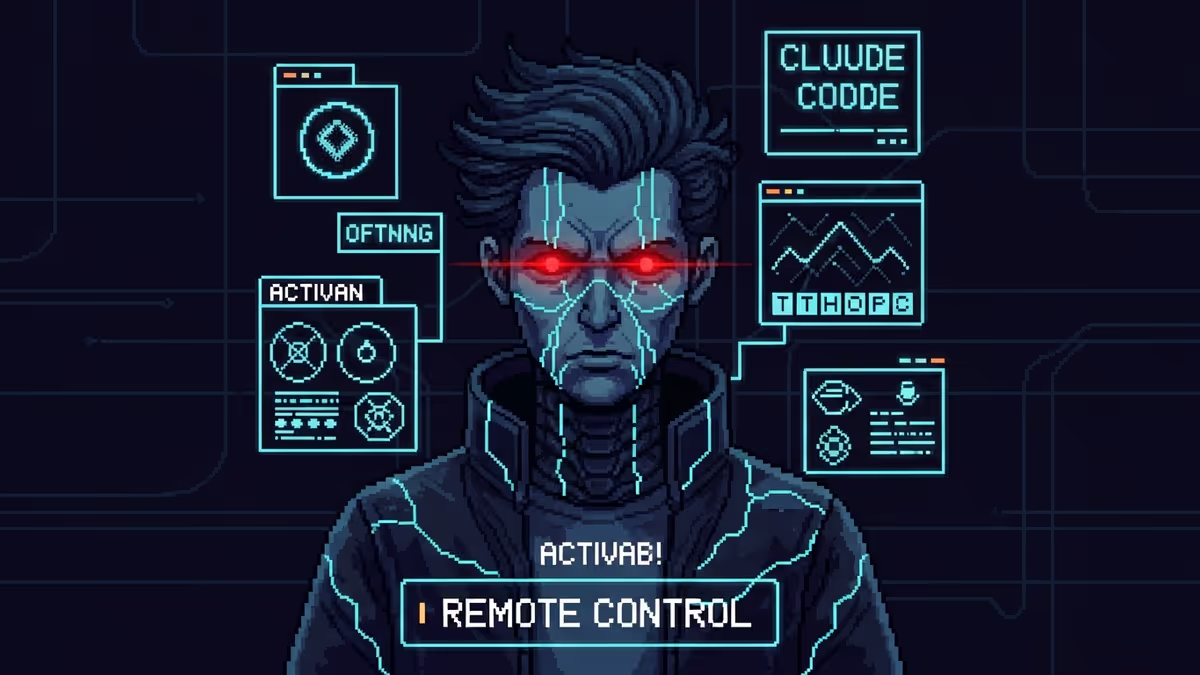
Claude Code activates "Remote Control" mode
For years we've accepted an implicit paradigm: programming work is done sitting in front of a screen. The code lives there, the tools are there, your attention must be there. Every time you step away from your workstation, you interrupt the flow. You leave Claude mid-session, lose context, interrupt the reasoning it was building.
But the reality of creative work—and software development is deeply creative—doesn't work that way. The best ideas come when you're walking. Problems get solved in the shower. The right architecture comes to mind while you're walking the dog. Our brain needs movement, breaks, different perspectives.
Cognitive continuity, not just technical
What Anthropic calls "Remote Control" is actually much more than device synchronization. It's the ability to maintain a continuous conversation with an AI assistant, regardless of where you are physically.
You start a session from your laptop terminal. Claude is analyzing a complex codebase, building a mental map of your project, understanding the architecture and conventions you use. Then you need to leave. Traditionally, all this context freezes, remains locked on that machine.
With the /remote-control command, that same session becomes accessible from your smartphone. You're not starting from scratch, you don't have to re-explain the context, you don't lose the thread of reasoning. You simply continue the conversation from another device.
Mobility as a right, not a privilege
There's something deeply democratic about this feature. Until now, access to the most powerful AIs was tied to specific configurations, expensive hardware, stable connections. If you wanted to fully leverage Claude for programming, you had to be seated at your workstation.
Now that barrier falls. You can start working on a complex problem with all the comfort of your main setup, then move wherever you want without losing anything. Claude's computational power remains the same, the context is preserved, only you change location.
This doesn't mean working more, it means working better. It means being able to take that break you need without the anxiety of losing the thread. It means being able to answer an urgent question while on the move, without having to wait to get back to your desk.
The price of flexibility
Naturally, this feature arrives first for Max users in research preview. It's understandable: Anthropic is testing something technically complex, needs to verify it works, needs to understand how it scales. But it still raises an interesting question about the future of access to AI tools.
Are we heading toward a world where the most useful features will be increasingly tiered by subscription levels? Where cognitive mobility will be a premium feature? It's a dynamic to watch, because tools like Claude Code are no longer simple conveniences, they're becoming essential infrastructure for modern intellectual work.
The phone as an extension of the mind
There's an elegant irony in the fact that the device often accused of distracting us now becomes a tool for maintaining focus on complex projects. Your smartphone is no longer just the place where you scroll social media and respond to messages, it becomes a direct extension of your development environment.
Imagine: you're walking in the park, you figure out how to solve that bug that was tormenting you. You pull out your phone, resume the session exactly where you left it, describe the solution to Claude, ask it to implement it. When you return to your desk, you find the code already modified, tested, ready to commit.
It's not science fiction. It's what /remote-control promises to enable.
The subtle revolution of persistence
The real innovation here isn't technical, it's conceptual. Claude Code with Remote Control normalizes the idea that our interactions with AI can and should persist across physical contexts.
When we talk about contextual memory in AI, we always think about the ability to remember previous conversations. But this is spatial memory: the ability to follow you physically, to be available regardless of where you are, while maintaining intact understanding of the work you're doing together.
It changes the very meaning of "assistant". An assistant that follows you, that is always synchronized, that doesn't need to be repeatedly updated. It's closer to how human collaboration actually works.
Toward liquid work environments
If this direction continues, and I believe it will, we're moving toward increasingly "liquid" work environments. The boundary between being "at work" and being "away from work" becomes more blurred, but paradoxically this could make us more free, not less.
When work is no longer bound to a specific place, when you can carry with you not just files but the entire cognitive context of what you're doing, you can truly choose how to structure your day. You can work intensely for two hours, take a real break without guilt because you know you can resume instantly, return when you're truly ready.
It's not the toxic "always on" we fear. It's the possibility of working according to the natural rhythms of human creativity and focus, with a tool that adapts to you, not vice versa.
What we still don't know
As always with previews, there are open questions. How is synchronization managed? How fluid really is the transition between devices? Are there limits to the complexity of sessions that can be transferred? Is latency acceptable on less-than-optimal mobile connections?
But beyond the technical details, which will surely be refined, the direction is clear. Anthropic is exploring how to make Claude not just more powerful, but more present. Not just smarter, but more available.
And perhaps this is precisely the next frontier of AI: not building ever larger and more capable models, but finding increasingly natural and human ways to integrate them into our real lives, made of movement, context changes, interruptions, need for flexibility.
Claude Code's Remote Control is a small step in that direction. But as often happens with technologies that truly work, it's a small step that opens much broader scenarios than it seemed at first.